


'Being Heumann' Review

Release Date: 11/13/26 [Apple TV]
Genre: Biography. Drama. History.
MPAA: Rated R.
Distributor: Apple Original Films.
The Verdict: A Maybe

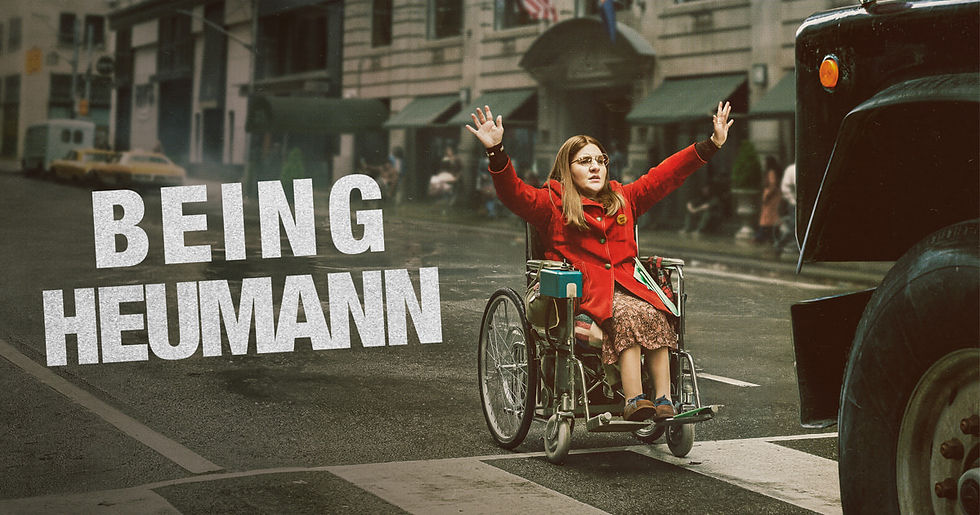
Watch Ruth Madeley take a beat before she speaks. As disability rights activist Judy Heumann, she pauses, looks around the room, and takes everything in. Her performance carries a naturalism that carries through Being Heumann, even when the writing gets a little too pleased with itself. Madeley powers and propels this movie.
Director Siân Heder, following her Oscar-winning CODA, assembles a broad cast of disabled actors and makes them feel equally present. Co-written with Rebekah Taussig, the film follows the 1977 occupation of a San Francisco federal building by protesters demanding enforcement of Section 504’s disability protections. They’re asking for access to bathrooms and public buildings – basic equality. But even with Jimmy Carter as president, they have to storm a government building to demand it.
It’s Mr. Smith Goes to Washington crossed with Almost Famous, with disabled people leading the charge in a fight for basic civil rights. This makeshift community has a summer-camp feel, a jubilation that grows as people get to know each other. Rebellion is contagious and joyous. It’s awkward, too, in a way that feels honest. People flirt. There’s romance. There’s sex.
And there’s also having to pee and finding somewhere to sleep. Figuring out how to be intimate when the space you’re occupying barely accommodates your body. The film does a good job of letting these everyday needs interrupt the grand business of making history. Everyone still has to live here, together, for however long this thing takes.
Charlie Rush-Reese is a particular pleasure as Dennis Billups, who grows into a leader without losing his initial sweetness. His is a small story within the larger one, but it’s among the touches that give this movie its spark.
Dylan O’Brien is magnetic as Evan White, a TV reporter who initially scoffs at the gathering of protesters in wheelchairs, then gets drawn in until he’s a true believer. Mark Ruffalo is at his Ruffalo-est as Joseph Califano, Carter’s health, education, and welfare secretary: frumped, frustrated, he tries to be the rational adult confronting a $2.4 billion problem. Here, that makes him something like the villain. That’s an interesting tension.
The dialogue can be painfully obvious: “I don’t know what to do!” “Have you tried talking to them?” Elsewhere, someone says something brave, and here come the rousing strings. That been-there-done-that movieness sometimes gets in the way of the film’s best moments.
And then there’s the context. There’s a lot to feel good about in this world. Even as the protesters defy the authorities, people bring them food, ramps, and mattresses. The protesters get to stay indoors. Watching from 2026, that generosity feels almost startling.
Heder shows some of the difficulty of holding a movement together, though the film’s warmth doesn’t always leave room for the dirt and exhaustion underneath. The aww-shucksness can make a messy, difficult fight feel a little too easy.
Still, this is a good movie, beautifully acted, with a sparky, infectious energy and an impressive sense of scale. Seeing this many disabled performers get to be funny, angry, awkward, and desired matters. So does the care with which they’re filmed. If only the writing could be as adventurous as the people in front of the cameras.
Madeley, especially. Give her the accolades, then give her another movie.
Where to Watch:


