


'A Long Winter' Review

Release Date: 01/22/27 [Cinemas]
Genre: Drama.
MPAA: Not Rated.
Distributor: MUBI.
Seen for New York Film Festival 2026.
The Verdict: A Maybe

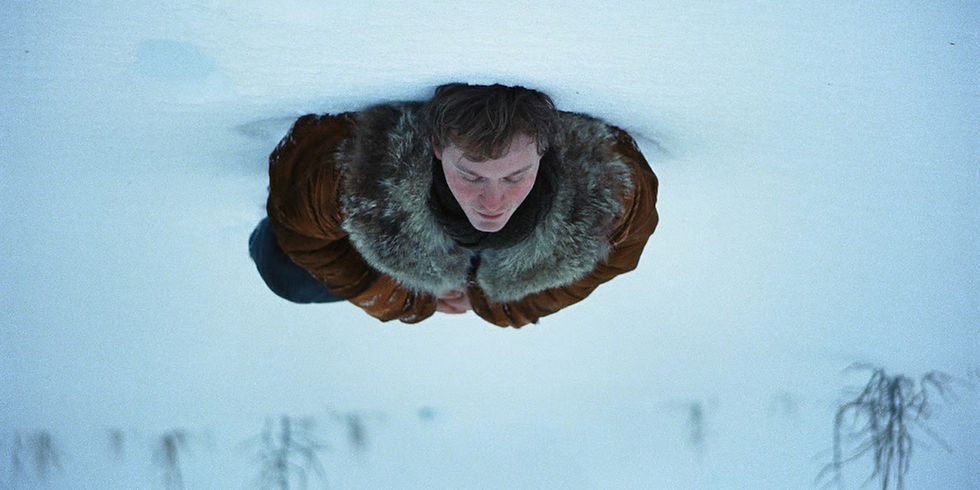
As the heavily-layered cast of Andrew Haigh’s A Long Winter trudges through the shin-deep snow of Alberta’s steep mountainside, you intensely feel the challenges that shooting this film presented. This is a movie that is the rare combination of emotionally intimate and technically grand. The square footage of the production is not too great—most of the film takes place in a modestly constructed home, with just a few treks into the whiteout. But it’s clear that it took a lot from everyone to just show up to set every day, not to mention all of the added demands of telling this story.
Haigh’s last film, 2023’s All of Us Strangers, was an emotional wallop, a feverishly beautiful, pitch-perfectly acted exploration of identity and homosexuality. It felt like an introspective dream brought to beaming life, with a clarity to its storytelling that made something that, on paper, seems ambitious feel so effortless. Matching what I was saying about the production itself, A Long Winter has to strain quite a bit more than Strangers did to achieve its goals. This is a gorgeously shot period drama that has Haigh’s fingerprints all over it, but it’s choppier and more distant, sometimes overcompensating.
Alberta subs in for Colorado in A Long Winter, an adaptation of a short story by Irish writer Colm Tóibín. Haigh, who has mostly told stories native to the U.K., takes his shot at a mid-20th century story set in the American Mountain West. Mikey (Fred Hechinger) has returned home from travels on the terrain. He comes back to find a home in passive aggressive turmoil. His father Lester (Ebon Moss-Bachrach) is a man of few words, a New York City transplant who was desperate to move his life to the mountains. He’s plenty happy tending to the chickens and chopping wood until he dies. Lester married Louise (Caitríona Balfe), a woman who longs to return to the other side of the mountain, where she grew up and where her brother Frank (Martin Freeman) still lives.
Louise sneaks a drink at every opportunity, much to the disdain of Lester and the shock of Mikey. It is truly the worst kept secret in the entire countryside. Her favorite son Tommy (Kit Connor, the soon-to-be Cyclops) abandons the family for service in the Korean War, adding to the distress that mom feels. One day, after a particularly confrontational intervention, she disappears on foot into the mouth of winter. Her fate is the big mystery of the final two acts of the film, as Mikey spends his free time searching far and wide for any sign of her return. It’s a dour situation, and the movie certainly ends up missing the powerful performance that Balfe gives in the early scenes.
Though she was not exactly the most stable caretaker, the impact of Louise’s disappearance is immediately felt on Lester and Mikey’s lifestyle. A Long Winter starts to build more and more of a distance between the father and son, particularly as we learn things about Mikey and his attractions. This is where Haigh most directly evokes that All of Us Strangers feeling. Mikey hallucinates striking visions of one of the handsome state troopers searching for his mother, and Haigh’s camera lingers longingly as Mike strokes the pages of half-clothed men from his mom’s Cosmopolitan Magazine. These feelings are exacerbated by the arrival of Jimmy (Reservation Dogs star D’Pharoah Woon-A-Tai), a compassionate caretaker who helps tend to the “women chores” that Louise left behind.
Hechinger gives a good performance, but at 26 years old, he feels a bit on the older side to be playing a character who is having the type of pubescent awakening that Mikey is experiencing. I don’t know if it's a case of miscasting, or if Haigh is making a point about how late these sexual epiphanies arrived in a more disapproving era. This is a good example of A Long Winter’s muddled emotional intentions. It’s a movie that feels like it needs to be obvious with its themes to compensate for its lack of story developments, and for the simplicity of its characters and settings. There were quite a few scenes where I felt the dialogue was too on-the-nose, and where I rolled my eyes at the intrusive and manipulative musical score. There isn’t much being said here about identity that hasn’t been said before in better movies.
Despite the limitations of its storytelling, there is a lot to admire about A Long Winter. The backdrop is really quite stunning, as waves and waves of snow-covered pine trees add to the isolationist vibe of the project. Moss-Bacharach gives a performance that is as cold as the landscape, which I mean as a compliment. He runs as much as he can with what feels like disappointing restrictions on the page, and in his hands, Lester feels like the kind of complicated and rigid man that he must be for the film to work in any meaningful way.
Andrew Haigh is a very good filmmaker, and good filmmakers make compelling art even when their films have severe flaws. A Long Winter plays exactly like a short story stretched to two hours. It has a great aesthetic, yet not nearly enough original thoughts to support that aesthetic. It is a movie about the compromise of dreams and desires, and the film itself is a bit compromised by its own deficiencies.
Where to Watch:


