


'Sentimental Value' Review

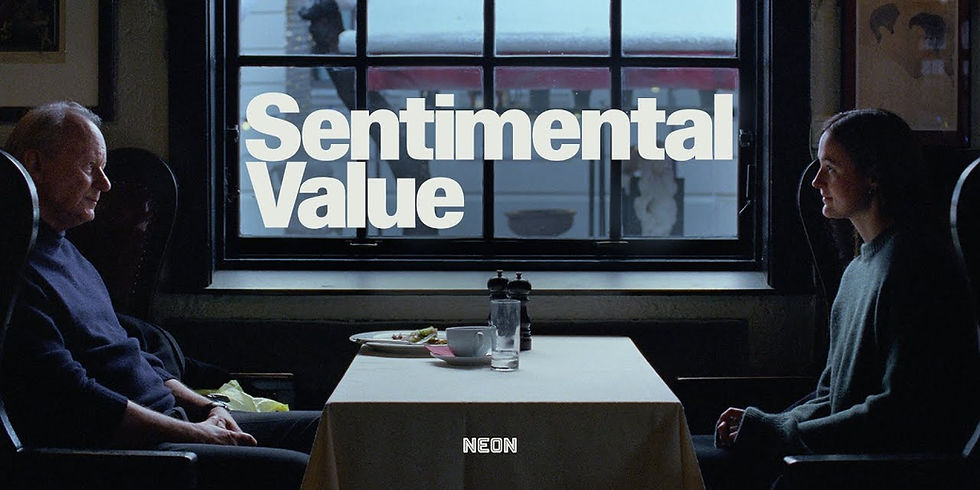
Release Date: 11/07/25 [Cinemas]
Genre: Drama.
MPAA: Rated R.
Distributor: Neon.
The Verdict: A Must-See

There is a scene midway through Joachim Trier’s Sentimental Value where Elle Fanning’s character, Rachel, implores fading filmmaker Gustav (Stellan Skarsgård) that she is not the right fit for a part he wants her to play in his upcoming film. That part belongs to someone else: Gustav’s daughter. Rachel bows out of the project, leaving Gustav no alternative but to fix his mistakes through earnest compassion and effort. This turning point strikes at the soul of this somber family drama. No matter who the surrogate is, a father cannot project the love he owes his daughter onto someone else.
After debuting at the Cannes Film Festival and picking up the Grand Prix Prize, Sentimental Value has slowly climbed into many 2025 Top Ten Lists, and for good reason.
Nora Borg (Renate Reinsve) and her sister Agnes (Inga Ibsdotter Lilleas) have lost their mother. Their father Gustav (Skarsgård) returns for the funeral, having left when the sisters were young. Hoping to revive his career, Gustav writes a personal film and asks Nora to play his mother. Still resentful over his abandonment, Nora refuses, so Gustav turns to American actress Rachel Kemp (Fanning).
Vignettes fill out the run time of Sentimental Value rather than conventional scenes, like acts of a play or chapters in a book. Each vignette reveals deeper detail about each character, who they are, and what their future may hold. There is no filler in this film; each moment ties into the last and catapults us into the next.
This film has a small cast, lending the deep character dives to take place. Renate Reinsve is masterful as Nora. The character is a stage actor, hence Gustav’s eagerness to put her talents into his film. In an early scene, Reinsve’s Nora suffers a panic attack before going on stage; her coldness and stoicism are explained as the movie unravels. The same with Gustav, a washed-up, adrift filmmaker who initially fails to see the disconnects he has brought into his own life. He is unaware of his personal shortcomings, as seen in a humorous scene, gifting his grandson highly inappropriate films for the boy’s birthday because Gustav considers them good cinema, as he is aware of his challenges to stay relevant as a filmmaker, by towing the company line with studios, leveraging the casting of Rachel Kemp to get the film funded. The unsung hero, Agnes, calmly guides us through the journey of her father and sister.
Some films often like to dump exposition early in the first act, contextualizing characters and motivations. Sentimental Value is not interested in spoonfeeding anything to its audience and instead allows the information to slowly reveal itself. This method of storytelling is engaging, and Agnes acts as the center of this knowledge through Lillea’s grounded performance. This world feels lived in, and the history between the characters thrives with integrity.
I must concede that a 2-hour and 15-minute Norwegian film about family drama might not be the most appealing hook for many audience members. I would submit, though, that this story is rich, deep, and, well, sentimental. For that reason, I recommend this experience. Sentimental Value makes me feel, makes me anxious, makes me happy. The rarity of a film to conjure so many different emotions can only be reconciled with the fact that it is exceptional. I won’t presume to be so bold as to say that this film is the reason award shows exist. But Sentimental Value is a veritable example of why film is so important to our species.


